
When the Landline Disappears
Another anecdote from my part-time gig at my local library
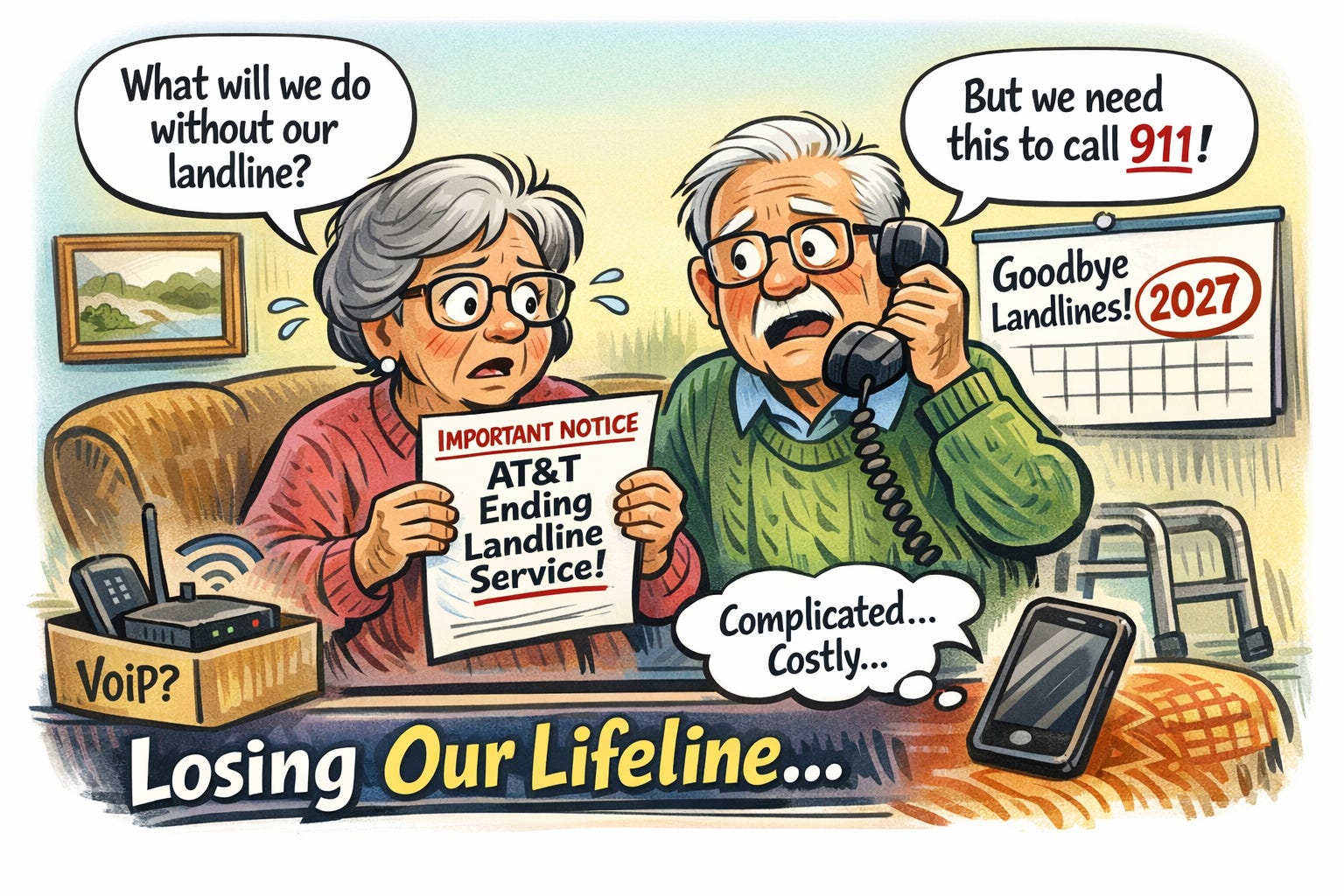
Today at the library, a patron came in with what started as a simple question. She thought she had lost a contact on her phone. We found it in a few minutes. Easy win.
Then she mentioned something that stopped me cold.
She said AT&T AT&T was eliminating landlines in our area in Illinois.
I immediately pushed back. “There’s no way,” I told her. People still rely on landlines. Seniors. People with medical needs. People who don’t want to carry a smartphone into the basement to do laundry. People who like phones in multiple rooms so they can answer wherever they are.
I was wrong.
According to the Citizens Utility Board, AT&T has been mailing letters announcing the end of its traditional copper landline service—“plain old telephone service.” The phaseout is scheduled to be complete after March 15, 2027.
Earlier this year, the Federal Communications Commission gave final approval for AT&T to discontinue its status as “carrier of last resort” in Illinois. In plain English: the company is no longer required to provide traditional landline service everywhere in the state.
As of mid-2024, more than 500,000 Illinois customers still had AT&T landlines.
That’s not a small number.
What Are the Options?
From what I’ve read, customers are generally being pushed toward:
Digital phone service (VoIP – Voice over Internet Protocol)
Cellular service, with the option to port your existing number
If a customer believes they’ll be left without reliable phone service—including access to 911—they can file a complaint with the Illinois Commerce Commission and request an investigation.
On paper, that sounds reasonable.
In real life, it’s overwhelming.
This Is About More Than Technology
The woman I worked with today was nearly in tears.
She and her husband don’t move around like they used to. They have multiple phones throughout the house. If it rings, they can grab it in the kitchen, bedroom, or basement. They don’t want to carry a cellphone everywhere. It has never been their habit.
And here’s the hard truth: we can talk about “modernization” all we want, but not everyone experiences technological change as progress.
For some people, it’s loss.
Loss of routine.
Loss of familiarity.
Loss of confidence.
Loss of security.
And when a letter from a telecom giant arrives announcing that something foundational is disappearing, it doesn’t feel like innovation. It feels like destabilization.
Corporations and the Reality of Aging
Do large corporations conduct user research with older adults before making these decisions?
Maybe. Maybe not.
But from the front lines of a public library, I can tell you this: seniors are often the last to be considered and the first to feel the consequences.
Many rely on:
Landlines for emergency reliability
Multiple handsets throughout the home
Simple devices with large buttons
Predictable, consistent systems
They are not looking for an app.
They are not looking for a bundle.
They are not looking for “smart home integration.”
They are looking for a dial tone.
What Libraries (and Communities) Need to Do
This is where we come in.
If you work in a library—or advocate for older adults—this is the moment to prepare.
We need to:
Understand VoIP options and how they work
Compare costs and reliability
Clarify what happens to 911 access
Help patrons port numbers correctly
Explain the tradeoffs honestly
Seniors deserve a clear, neutral explainer. Not a sales pitch. Not a tech brochure. Not corporate spin.
Plain language. Real choices. Real implications.
Because right now, many of them are opening letters that feel like eviction notices from a system they’ve used for decades.
A Bigger Question
We eliminated our landline years ago. All we got were robocalls. For many families, this transition happened naturally.
But transitions should be navigable—not forced.
And modernization should not come at the expense of the people least equipped to manage sudden change.
Technology moves fast. Infrastructure shifts. Markets evolve.
But human beings age.
And stability matters.
If you support seniors in your community, start asking questions now. This change may already be headed your way.
Because today it was AT&T in Illinois.
Tomorrow it may be something else.
And I’m tired of watching patrons walk into the library carrying stress that corporations created.
We can’t stop every shift in technology.
But we can make sure no one faces it alone.